 English
 Español
 Deutsch
 日本語
日本語 中文简体
中文简体How Do You Choose the Right Auto Tail Lamp for Performance and Compliance?
Home / News / Industry News / How Do You Choose the Right Auto Tail Lamp for Performance and Compliance?



Our team is proud to offer on time guarantee and product guarantee to customer satisfaction.
Read More
Content
The auto tail lamp is one of the most safety-critical and visually consequential components on any vehicle. Positioned at the rear of the car, it communicates braking intent, directional change, and presence in low-visibility conditions to every driver behind. A failure in auto tail lamp function — whether through inadequate luminous intensity, non-compliant signal timing, lens degradation, or electrical fault — can directly contribute to rear-end collisions, with consequences ranging from property damage to serious injury.
At the same time, the auto tail lamp has become one of the primary surfaces for automotive styling expression. From the sweeping LED light signatures of European luxury sedans to the aggressive sequential turn signal systems of tuned JDM vehicles, the rear lamp assembly is a design centerpiece that brand strategists, vehicle modifiers, and aftermarket buyers invest heavily in optimizing. For automotive product engineers, sourcing managers, and modification shop operators, understanding auto tail lamp technology at both the engineering and commercial level is essential to sourcing decisions that deliver safety, compliance, and visual impact simultaneously.
This article provides an engineer-grade analysis of auto tail lamp systems — covering light source technology, optical design, regulatory compliance frameworks, lens and housing engineering, electrical architecture, and OEM/ODM sourcing strategies — designed for B2B automotive buyers, distributors, and modification professionals worldwide.
| # | Long-Tail Keyword | Search Intent |
|---|---|---|
| 1 | LED auto tail lamp upgrade kit | Vehicle modification / performance upgrade sourcing |
| 2 | sequential auto tail lamp manufacturer | JDM / European tuning style sourcing |
| 3 | smoked lens auto tail lamp wholesale | Bulk aftermarket parts / reseller procurement |
| 4 | OEM auto tail lamp supplier custom design | Private label / vehicle-specific fitment development |
| 5 | auto tail lamp assembly replacement for Japanese Korean cars | Specific model fitment / direct replacement procurement |
For decades, the halogen incandescent bulb defined auto tail lamp technology. Understanding its operating principles clarifies why it has been systematically displaced by LED technology across every performance dimension:
LED technology has fundamentally redefined the performance envelope of the auto tail lamp across every technical parameter:
OLED technology is emerging in premium OEM auto tail lamp applications (BMW, Audi OLED rear light signatures) and is beginning to enter the high-end aftermarket. Unlike point-source LEDs, OLED panels emit light uniformly from a flat surface — enabling ultra-thin, homogeneous light signatures with no visible individual LED hot spots. Current limitations for aftermarket and volume OEM applications: cost (OLED panel cost 8–15× equivalent LED area), operating temperature sensitivity (OLED efficiency and lifespan degrade significantly above 85°C junction — a challenge in compact automotive housing environments), and luminous output (OLED maximum luminance currently below ECE R7 stop lamp requirements without supplementary LED fill). OLED is positioned as a design differentiation technology for premium vehicles and is not yet viable as a mainstream auto tail lamp platform for volume aftermarket applications.
The optical system of an auto tail lamp governs how light from the source is directed, shaped, and distributed to meet regulatory photometric requirements. Three principal optical architectures are used:
The outer lens of the auto tail lamp serves simultaneously as an optical element (controlling light distribution by refraction), an environmental barrier (sealing the internal optics against moisture, dust, and UV), and a styling surface (defining the rear lamp aesthetic of the vehicle):
ECE regulations govern auto tail lamp approval for vehicles sold in Europe (EU), most of Asia, and over 55 signatory countries worldwide. The primary ECE regulations applicable to rear lighting:
US market auto tail lamp products must comply with Federal Motor Vehicle Safety Standard 108 (FMVSS 108), administered by NHTSA (National Highway Traffic Safety Administration). Key divergences from ECE standards:
For the large and rapidly growing China domestic and export market, auto tail lamp compliance is governed by GB (Guobiao) standards administered by the Ministry of Industry and Information Technology (MIIT) and tested at China Automotive Technology Research Center (CATARC):
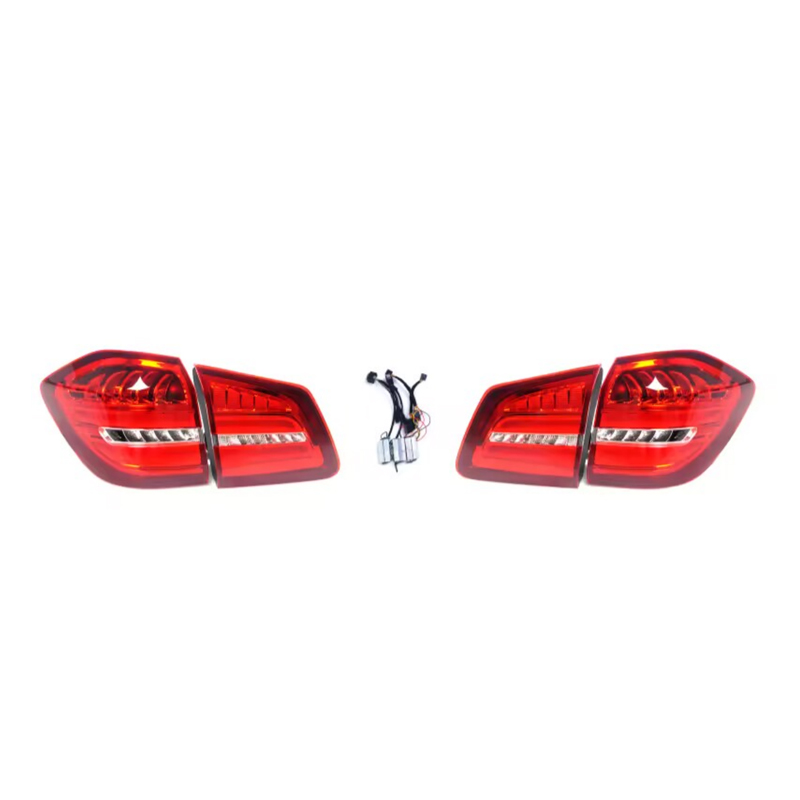
LED auto tail lamp upgrade kits are available in two fundamentally different formats, each with distinct technical implications for the installer and end user:
The sequential (sweeping) turn signal is the most commercially demanded visual effect in aftermarket auto tail lamp design — producing a left-to-right or right-to-left illumination sweep that signals turning direction with a dynamic, intentional visual motion cue. Engineering the sequential effect within regulatory constraints requires:
LED junction temperature is the primary determinant of both luminous output and service life in any auto tail lamp assembly. Inadequate thermal management is the most common engineering failure mode in low-quality aftermarket LED tail lamps:
The housing of an auto tail lamp assembly must simultaneously provide structural integrity for mounting load-bearing, environmental sealing against moisture and dust ingress, thermal management for heat dissipation, and dimensional precision for lens-to-housing interface sealing:
The joining method between lens and housing is a critical quality variable in auto tail lamp manufacturing — determining seal integrity, optical alignment precision, and serviceability:


If you are interested in our products, please consult us
No.280, Xincun, DongJia Village, Menghe Town, Xinbei District, Changzhou, Jiangsu, China.
+86-13915098651
+86-18068774710
+86-18068791866
+86-519-68885718
Changzhou Xinkai auto parts Co., Ltd. All Rights Reserved. Custom Automotive Exterior Accessories Manufacturers
