


Our team is proud to offer on time guarantee and product guarantee to customer satisfaction.
Read More
Content
Vehicle lighting systems have evolved significantly over the past decade. Modern drivers and fleet managers demand better visibility and improved safety metrics. An Auto Headlamp Upgrade Kit provides a direct solution for outdated halogen lighting. These kits replace factory bulbs with advanced light sources. They dramatically improve down-road illumination and peripheral vision. B2B procurement specialists often source these kits to upgrade large vehicle fleets. Better lighting reduces nighttime accident rates. We will explore the technical aspects of these lighting systems in this guide.
Engineers categorize modern vehicle lighting into three primary technologies. These include halogen, Light Emitting Diode (LED), and High Intensity Discharge (HID). Halogen bulbs rely on a heated tungsten filament inside a halogen gas-filled envelope. This technology is inefficient because it converts most energy into heat. LED technology uses semiconductors to emit light. This method operates at a much lower temperature and uses power efficiently. HID systems pass an electrical arc through xenon gas to produce an intense white light. Each technology offers distinct advantages for automotive engineers.
LED lighting dominates the current upgrade market. LED headlight conversion kits forcars systems feature complex internal architectures. The core components include the LED chip, a constant current driver, and a thermal management system. Engineers must match the LED chip size to the factory reflector or projector housing. Improper chip placement causes severe light scatter. The driver regulates the voltage from the vehicle's electrical system to protect the LEDs. Thermal management usually involves aluminum heat sinks or active cooling fans. Heat dissipation determines the operational lifespan of the unit.
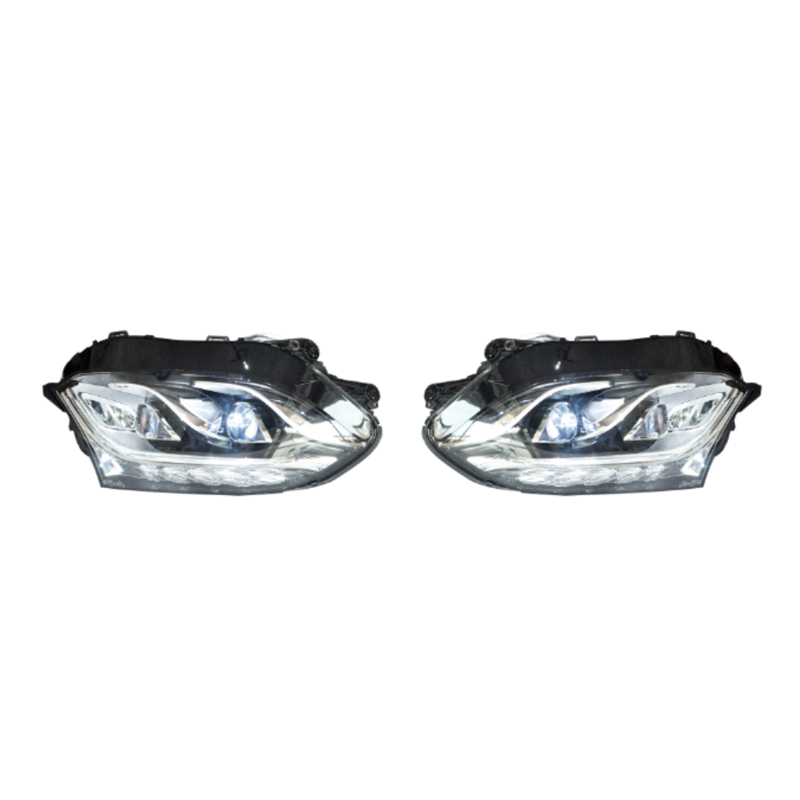
Procurement teams often debate between HID and LED technologies. Both options outperform standard halogen bulbs. However, their operational mechanisms differ greatly. HID bulbs require an initial high voltage strike to ignite the gas. This process causes a slight delay in reaching full brightness. LEDs reach full illumination instantly. HID systems produce more raw lumens per bulb. LED systems focus their lumens more precisely due to their compact size. The choice impacts the optical performance of the entire headlamp assembly.
Thermal dynamics play a crucial role in lighting performance. HID bulbs operate at very high temperatures. They radiate heat outward into the headlamp housing. LEDs generate heat at the rear of the bulb base. This concentrated heat requires robust heat sinks. Electrical loads also differ significantly. HID systems draw high initial current but settle to a lower operating wattage. LED systems maintain a constant, low current draw. These factors dictate the necessary wiring harness upgrades for safe installation.
Engineers compare these lighting technologies using specific measurable metrics. These metrics include luminous flux, power consumption, color temperature, and operational lifespan. The following comparison highlights the technical differences between standard halogen, HID, and LED upgrade options. Procurement managers use these metrics to specify requirements for fleet upgrades.
| Specification | Standard Halogen | HID System | LED System |
| Luminous Flux | 1000 to 1500 Lumens | 3000 to 5000 Lumens | 2000 to 4000 Lumens |
| Power Consumption | 55 Watts | 35 Watts | 25 to 40 Watts |
| Color Temperature | 3200K to 4000K | 5000K to 6000K | 6000K to 6500K |
| Operational Lifespan | 500 to 1000 Hours | 2000 to 3000 Hours | 30000 to 50000 Hours |
Sourcing automotive lighting components at scale requires strict quality control. Wholesale auto headlamp upgrade kit buyers must evaluate factory capabilities thoroughly. Suppliers must provide consistent luminous flux binning across large batches. Inconsistent lighting output creates compliance issues for vehicle distributors. Buyers should audit the supplier for automated optical testing equipment. This equipment ensures every unit meets photometric standards before packaging.
Automotive lighting components face rigorous international regulations. Suppliers must comply with regional standards like ECE in Europe or SAE in North America. These standards dictate beam patterns and intensity limits. Procurement specialists must verify certification documents for every production run. Logistical packaging also requires attention. Bulb bases and delicate LED components need protective void fill to prevent shipping damage.
Headlamp assemblies feature separate reflectors or projectors for low and high beams. Upgrade kits must address these optical differences. A low beam requires a sharp cutoff line to prevent blinding oncoming traffic. A high beam requires a wide, intense pattern to illuminate the driving lane. Engineers design specific LED bulb shapes for these distinct functions.
The factory headlamp housing dictates the compatible upgrade components. High-beam and low-beam headlight upgrade kit designs vary based on the housing type. Reflector housings rely on the exact filament placement of the original bulb. LED replacements must position their emitting chips at the same optical center. Projector housings use a lens to focus the light. Projectors can often tolerate slight variations in LED chip placement. Suppliers should provide specific compatibility matrices for their product lines.
Bulb base standards ensure physical and electrical compatibility. The 9005 base is a common standard for high beam applications in many vehicle platforms. Engineers specify this base for its single-filament design and high wattage capacity. Modern 9005 LED upgrades must overcome the physical constraints of the base socket while maximizing light output.
The 9005 socket presents unique thermal challenges. The factory housing often seals tightly around the base. This tight seal traps heat generated by the LED driver and cooling fan. 9005 LED bulb specifications mandate a specific base diameter to ensure proper fitment. Engineers use copper circuit boards and aerospace-grade thermal paste to transfer heat away from the diodes efficiently. The external driver box design helps relocate some heat-generating components outside the sealed headlamp housing.
Proper installation determines the actual performance of the upgrade. Technicians must follow precise procedures to ensure reliability. The installation process involves accessing the headlamp housing, removing the factory bulb, and installing the new unit. Wiring routing is a critical step in this process.
Modern vehicle networks monitor electrical circuits constantly. When a standard halogen bulb fails, the resistance drops. The vehicle computer detects this drop and triggers a warning light. LED bulbs draw much less current than halogen bulbs. The vehicle computer interprets this low current as a burned-out bulb. This phenomenon causes dashboard errors and flickering lights.
Technicians solve this issue by installing external load resistors or inline decoders. A plug-and-play headlight upgrade kit with CAN bus includes these integration components in the package. Load resistors add electrical load to mimic the halogen bulb's current draw. Decoders intercept the pulse-width modulation signals from the vehicle computer and provide a steady current to the LEDs. Proper integration ensures stable illumination and prevents false error codes on the dashboard.
No, high-quality upgrade kits use plug-and-play connectors. These connectors match the factory socket exactly. Technicians should never splice into the factory wiring harness. Splicing voids vehicle warranties and creates corrosion risks. The kit should connect directly to the factory bulb socket and the vehicle battery for power.
Local regulations vary regarding aftermarket modifications. Generally, manufacturers only void the warranty on the specific modified component. An aftermarket bulb kit does not automatically void the entire vehicle warranty. However, if the upgrade kit causes thermal damage to the factory housing, the dealer may refuse warranty coverage for the housing replacement.
Scattered beam patterns occur when the light-emitting chips do not align with the original filament location. The reflector or projector lens is calibrated for a very specific light source position. If the LED chips sit too far forward or backward, the light reflects in the wrong direction. Purchasers must select bulb designs that match the optical center of their specific housing type.
Color temperature measures the visual appearance of the light in Kelvin. Factory halogen bulbs produce a yellowish light around 3200K. Most LED kits produce a pure white light around 6000K. This white light improves road sign contrast and driver alertness. However, color temperatures above 6500K produce a blue tint. This blue tint reflects poorly off wet roads and decreases visibility in rain or fog.


If you are interested in our products, please consult us
No.280, Xincun, DongJia Village, Menghe Town, Xinbei District, Changzhou, Jiangsu, China.
+86-13915098651
+86-18068774710
+86-18068791866
+86-519-68885718
Changzhou Xinkai auto parts Co., Ltd. All Rights Reserved. Custom Automotive Exterior Accessories Manufacturers

 English
 Español
 Deutsch
 日本語
日本語 中文简体
中文简体